
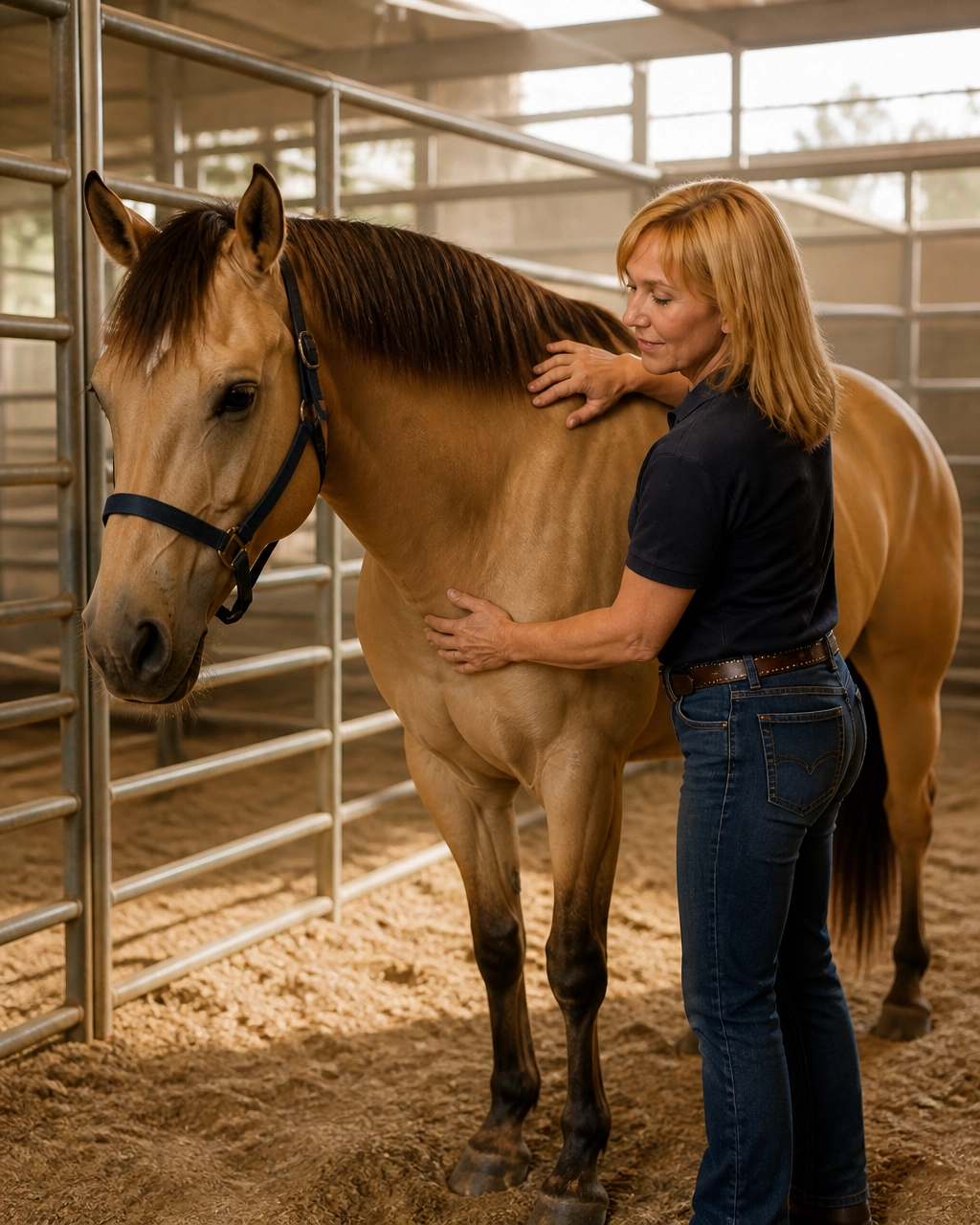
Calling a veterinarian is always the first choice for unexplained swelling, heat, pain, lameness, weakness, neurological signs, fever, wounds, or sudden changes. This article is educational and is not a diagnosis or a substitute for veterinary advice.
Published September 5, 2026 | Last updated September 5, 2026
By Christa Martin, CEMST, Horsealytics equine wellness and recovery services
Stall living hits hard in Southern California, where expensive dry-lots and limited pasture boarding can reduce turnout options for some horses. While normal stall living includes adequate movement and socialization, true stall confinement severely restricts motion due to facility limits or management constraints, leading to stiffness, fluid pooling, and topline changes. Whether your horse is recovering from stall rest or handling limited turnouts across Southern California, professional equine massage and bodywork can be a beneficial way to help restore comfort and mobility.
Ideally, many horses do well with substantial daily turnout to support continuous movement, digestion, and tissue health, as outlined by Equus guidance on how much turnout a horse may need. When regional constraints, limited dry-lots, or boarding rules make that level of free movement difficult, owners often have to bridge the gap through targeted management: supplementing with structured hand-walking or ridden exercise, utilizing slow-feeders to mimic natural foraging trickle-loads, keeping stalls enriched, and incorporating professional equine massage and bodywork to help manage stiffness, fascia restriction, and fluid pooling that may develop with restricted turnout.
What changes inside the horse when they're just standing around, and what should owners notice?
Quick Summary
Stall living can work well when it is balanced with turnout, controlled exercise, forage, enrichment, and social contact. Stall confinement is different because movement is more restricted. That restriction may affect swelling, tissue tone, movement comfort, and topline over time, depending on the horse, the reason, and the veterinary plan.
The phrase “trickle-charge movement” is a useful plain-language metaphor for the small movements that support joint motion, muscle activity, and fluid exchange throughout the day. It does not mean lymphatic flow or fascial mobility literally falls to zero.
Horsealytics’ experience with equine bodywork in San Diego, CA, includes observing horses whose posture and tissue tone change during periods of confinement. Photobiomodulation is the technical term often used for red light therapy. The NeoRhythm OmniPEMF Pad is a named PEMF tool used in Horsealytics’ service context. These services are supportive wellness options, not cures or replacements for rehabilitation.
What happens to a horse’s tissues during stall confinement, and how is that different from stall living?
Stall living does not automatically create the same physical effects as stall confinement. A horse that spends part of the day in a stall but still has turnout, controlled exercise, forage access, enrichment, and social contact may keep much more normal daily movement. Stall confinement is different because the horse usually takes fewer steps, changes position less often, and loads the body in a narrower range of patterns.
Reduced movement means fewer gentle muscle contractions, fewer joint cycles, and less regular loading through the limbs and back. Muscles in the lower legs help support venous and lymphatic return when the horse moves. This is one reason a horse may develop temporary filling, commonly called stocking up, after standing for a long time.
However, swelling has many possible causes. Reduced movement can contribute to fluid pooling, but it does not prove that circulation is the only issue.
Joint motion also matters because movement helps distribute synovial fluid across joint surfaces. Long periods of inactivity may contribute to stiffness, especially when a horse already has arthritis, pain, injury, or weakness. The controlled exercise review in equine rehabilitation explains why rehabilitation commonly progresses from rest toward carefully directed movement. Additional context comes from peer-reviewed research on the physiological effects of long-term limb immobilization in horses, which helps explain why restricted movement can affect soft tissues and normal limb function.
A horse may also experience:
- Less dynamic muscle engagement
- Reduced fitness and strength
- Lower confidence when moving
- Changes in posture and weight distribution
- Increased sensitivity from pain, compensation, or deconditioning
The degree of change depends on the horse’s age, health, stall size, footing, forage access, turnout, nutrition, diagnosis, and veterinary plan.
Why can a stalled horse develop swelling in the lower legs?
Benign stocking up often appears as fairly even, cool, non-painful filling in the lower limbs after inactivity. It may improve when the horse is allowed appropriate movement, but owners should not assume every swollen leg is harmless.
| What owners may notice | Possible meaning | Why veterinary context matters |
|---|---|---|
| Mild, even filling in more than one leg | Stocking up related to inactivity may be possible | The horse’s history and response to approved movement still matter |
| One leg is larger, hot, or painful | Injury, inflammation, infection, or another problem may be present | Uneven or painful swelling needs assessment |
| Swelling increases quickly | Acute injury, infection, or circulatory concern is possible | Rapid change should not be watched casually |
| Filling continues or has no clear cause | More than simple inactivity may be involved | Persistent unexplained swelling requires veterinary guidance |
Persistent, hot, painful, asymmetric, rapidly increasing, or unexplained swelling needs veterinary assessment.
Why can the back and topline look different after stall rest?
The longissimus dorsi, multifidus, abdominal muscles, gluteals, and other postural muscles help support the horse during movement. When those muscles are not challenged normally, they may become less active or lose condition. This can contribute to the familiar concern about a horse’s topline after stall rest.
A quiet or hollowed topline does not prove muscle loss. Its appearance can also reflect:
- Pain or protective posture
- Reduced overall conditioning
- Nutrition or weight change
- Saddle fit
- Disease
- Age-related changes
- Altered movement caused by an injury
Research and veterinary observation support concern about disuse and muscle atrophy, but a visual topline assessment is not a diagnosis. The overview of equine muscle atrophy explains why muscle change should be considered alongside the horse’s full history. For more on postural support relationships, see Horsealytics’ guide to the equine muscular sling and spinal support.
Why does a horse often take shorter steps after standing around all day?
The first ten steps after release can show reduced reach, hesitation, stiffness, or a cautious hind-end pattern. These observations may reflect deconditioning, reduced confidence, joint stiffness, pain, or an underlying veterinary condition.
The first steps are useful observations, not a diagnostic test. A horse should not be assumed to need more movement simply because it looks stiff. The correct response depends on why the horse was confined and what movement the veterinarian has approved.
What is the stall-living stagnation loop?
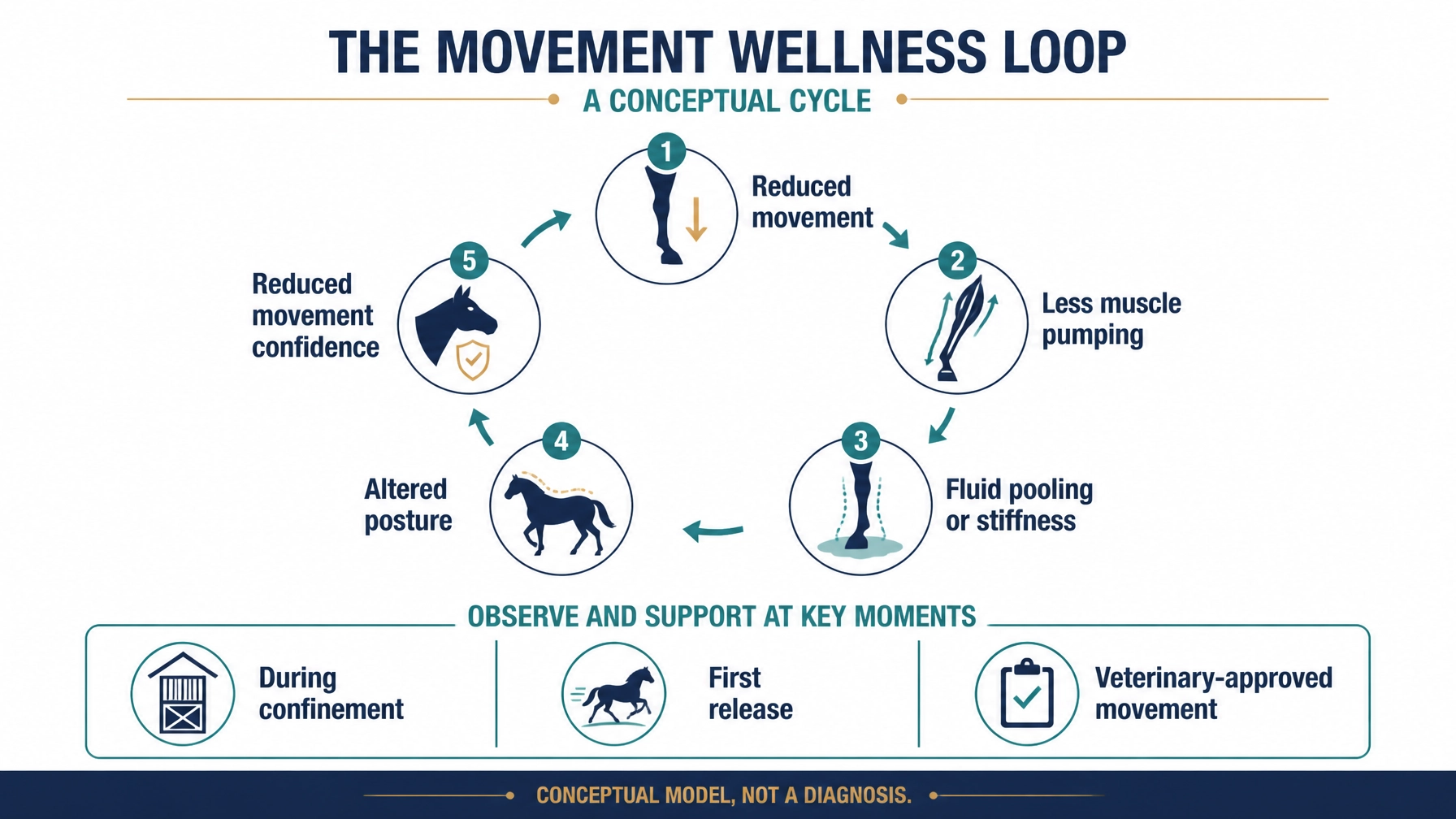
The following is a conceptual model, not a diagnosis.
| Stage | What may happen |
|---|---|
| Reduced movement | The horse takes fewer steps and cycles the joints less often |
| Less muscle pumping | Lower-leg muscle contractions occur less frequently |
| Fluid pooling or stiffness | Lower-limb filling or generalized stiffness may become more noticeable |
| Altered posture | The horse may shift weight or brace in a preferred position |
| Reduced movement confidence | The horse may take shorter, more careful steps, which reinforces inactivity |
This loop does not occur in every horse, and it can be interrupted or changed by veterinary treatment, approved exercise, suitable turnout, nutrition, and careful management.
“True stall confinement traps the horse in a stagnation loop where reduced movement leads to fluid pooling, fascial restriction, and topline changes—making targeted equine bodywork essential for horses missing out on natural Southern California turnout.”
Christa Martin, CEMST, Horsealytics
What is asymmetrical compressive loading in a stall?
A horse may repeatedly shift weight, rest on one preferred side, brace against a wall, or stand with the neck and body in a consistent position. Over time, this can create localized soft-tissue loading around the shoulder, hip, stifle, or back.
This does not mean fascia universally dehydrates or binds down. A better explanation is that reduced movement and repeated positioning may influence tissue comfort, posture, and movement habits in some horses.
Asymmetry can also be caused by pain or injury. That is why a practitioner should treat asymmetry as an observation to share with the veterinary team, not as proof of a muscular cause.
Which muscle groups may need professional attention after stall confinement?
This educational diagram shows muscle groups and support regions that may be considered during a professional assessment. It is not a diagnostic map.
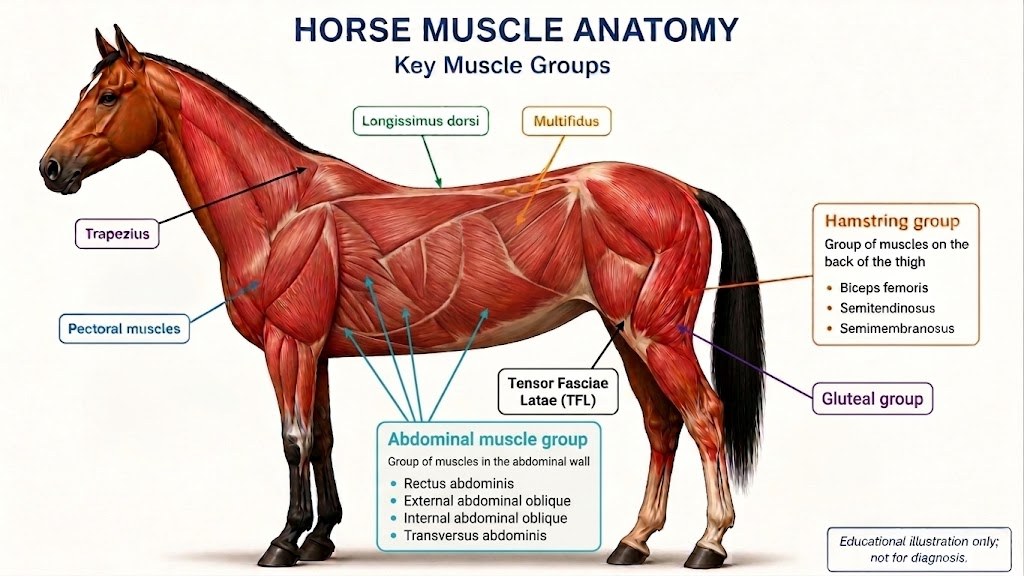
Anatomical diagrams are educational illustrations; they do not identify pain or diagnose injury.
A practitioner may observe the thoracic sling, back stabilizers, abdominal support, gluteal group, hamstring group, shoulder and pectoral region, and distal-limb soft tissues because these areas often reflect how the horse has been carrying weight, limiting motion, or compensating during restricted movement.
The thoracic sling helps suspend the trunk between the forelimbs. The back stabilizers, including the longissimus dorsi and multifidus, help support spinal control during movement. The abdominal muscles contribute to postural support. The gluteal group and hamstring group help with propulsion, hip extension, and hindquarter effort. In the hindquarter region, the hamstring group refers to a group of muscles, not one single muscle, and may include the biceps femoris, semitendinosus, and semimembranosus. The shoulder and pectoral region may show tension or guarding when a horse has been bracing in place. Distal-limb soft tissues may also matter because inactivity can change loading patterns and make filling or sensitivity more noticeable.
Observation, palpation, or bodywork does not diagnose the cause of soreness. These findings are best treated as soft-tissue and movement observations that may help the owner and veterinary team decide what needs further assessment.
Why does anatomically informed bodywork matter for a stall-bound horse?
Anatomical knowledge helps a qualified practitioner understand relationships among the muscular sling, shoulders, rib cage, spine, pelvis, fascia, and limbs. It also helps the practitioner stay within soft-tissue boundaries, notice unusual sensitivity or asymmetry, and refer concerning findings to a veterinarian.
Horsealytics’ equine massage therapy guide explains why professional bodywork should be connected to veterinary care, training, saddle fit, farriery, and conditioning.
How can bodywork support a horse returning from stall living?
Supportive bodywork may help a qualified practitioner observe changes in tissue tone, movement comfort, asymmetry, or sensitivity within an approved care plan. It may also give the owner and veterinary team useful observations about how the horse responds to touch and posture changes.
Professional bodywork may help a care team observe changes in tissue tone, movement comfort, asymmetry, or sensitivity, but it does not replace veterinary assessment, turnout, controlled exercise, rehabilitation, or appropriate management.
Soreness is a clue, not a diagnosis. Bodywork cannot replace veterinary evaluation, prescribed rehabilitation, or a gradual return to appropriate movement.
Turnout needs vary by horse, facility, season, health status, and veterinary direction, so movement plans should match the individual horse rather than a single rule.
“A sore horse is not a happy horse; when a stalled horse lacks the 8 to 12 hours of daily movement nature intended, anatomically informed bodywork acts as a vital tool to manage stiffness and support overall recovery.”
Christa Martin, CEMST, Horsealytics
References
- Equus guidance on how much turnout a horse may need
- Controlled exercise review in equine rehabilitation
- Peer-reviewed research on the physiological effects of long-term limb immobilization in horses
- Overview of equine muscle atrophy
- UC Cooperative Extension horse-care guidance
- Extension Horses guidance on designing and managing dry lots for horses
How can red light therapy and PEMF fit into supportive care?
Photobiomodulation, commonly called red light therapy, uses specific light wavelengths in wellness and rehabilitation settings. PEMF uses pulsed electromagnetic fields. Evidence, device settings, treatment goals, and manufacturer claims vary.
The NeoRhythm OmniPEMF Pad may be used in Horsealytics’ San Diego, CA service context according to practitioner and veterinary guidance. It should not be presented as a guaranteed treatment, cure, or replacement for rehabilitation.
Learn more in Horsealytics’ guide to Omni Perf PEMF settings for horses.
What should Southern California horse owners ask about boarding?
Southern California horse owners may encounter limited dry-lot pasture boarding, high turnout costs, heat, drought, and facility-specific space limits. This is a regional management challenge, not proof that every barn lacks good turnout.
| Boarding question | Why it matters |
|---|---|
| How much turnout is available, and is it individual or group turnout? | Movement and social contact vary by horse and facility |
| Is the footing safe, level, and maintained? | Poor footing can add strain or discourage movement |
| Are shade, water, ventilation, and forage access reliable? | These affect comfort and daily behavior |
| Is controlled exercise available when turnout is limited? | A veterinary-approved plan may require more than stall time |
| What happens during heat, injury, illness, or emergencies? | Clear procedures support safer care |
| Can the barn explain its dry-lot design and enrichment options? | Layout can influence how much a horse moves |
The UC Cooperative Extension horse-care guidance and Extension Horses guidance on designing and managing dry lots for horses provide useful background for evaluating housing and turnout choices.
“When regional dry-lots and limited boarding cut a horse’s turnout down to a rushed hour a day, professional equine massage bridges the gap by helping restore tissue mobility, comfort, and fluid drainage.”
Christa Martin, CEMST, Horsealytics
What should owners observe during a return from stall confinement?
There is no universal exercise protocol. The timeline below is for observation and communication with the veterinary team.
| Time or situation | What to observe | Why it matters |
|---|---|---|
| During confinement | Leg filling, posture, appetite, behavior, and comfort | Establishes changes from the horse’s normal pattern |
| First release | Step length, hesitation, symmetry, and willingness to move | Shows how the horse appears after inactivity |
| After veterinary-approved movement | Changes in swelling, comfort, and muscle response | Helps the care team evaluate tolerance |
| Ongoing return to work | Topline, strength, stride quality, recovery, and behavior | Tracks conditioning without assuming a diagnosis |
Frequently asked questions about stall living versus stall confinement
Is stall living the same as stall confinement?
No. Stall living means the horse spends time in a stall as part of a broader management plan that may still include turnout, controlled exercise, forage access, enrichment, and social contact. Stall confinement means movement is more significantly restricted.
Is stall rest bad for horses?
Stall rest can be necessary and protective after injury or surgery. The concern is prolonged or poorly monitored inactivity, which may contribute to stiffness, muscle loss, swelling, stress, and deconditioning.
Why does my horse stock up in a stall?
Standing with little movement can reduce the muscle activity that supports venous and lymphatic return from the lower limbs. Stocking up may be benign, but heat, pain, asymmetry, rapid increase, or persistence needs veterinary assessment.
Can stall rest cause muscle loss?
Reduced activity can contribute to disuse-related muscle loss, especially when confinement lasts a long time. The amount varies with the horse’s age, nutrition, diagnosis, and approved rehabilitation plan.
Why is my horse stiff when leaving the stall?
Stiffness may reflect inactivity, reduced confidence, deconditioning, joint disease, pain, or another medical issue. The first steps are observations, not proof of a specific cause.
Can equine massage help after stall confinement?
Professional equine bodywork may support comfort, relaxation, and observation of soft-tissue changes when appropriate. It should be coordinated with veterinary care and should not be used to mask unexplained pain.
Can PEMF or red light replace turnout or veterinary care?
No. PEMF and photobiomodulation are complementary wellness modalities. They cannot replace safe movement, turnout decisions, rehabilitation, or veterinary diagnosis and treatment.
How long does it take a horse to regain topline?
There is no single timeline. Recovery depends on the reason for confinement, muscle loss, nutrition, pain status, conditioning, and the veterinary-approved return-to-work plan.
What signs mean swelling is more than stocking up?
Heat, pain, one-sided swelling, rapid enlargement, lameness, wounds, fever, or unexplained persistent swelling are warning signs. Calling a veterinarian is the safest next step.
What should I ask a Southern California boarding barn?
Ask about turnout, dry-lot footing, shade, water, ventilation, forage access, controlled exercise, enrichment, emergency procedures, and how the barn manages horses that require stall rest.
What is the safest final takeaway about stall confinement?
Calling a veterinarian is always the first choice for unexplained swelling, heat, pain, lameness, weakness, neurological signs, fever, wounds, or sudden change.
Equine bodywork, red light therapy, and PEMF are supportive wellness services and never substitutes for veterinary diagnosis or treatment. Horsealytics provides horse massage and supportive recovery services for horse owners. Call (858) 848-9862 or visit the Horsealytics Facebook page.
“A sore horse is not a happy horse!”