
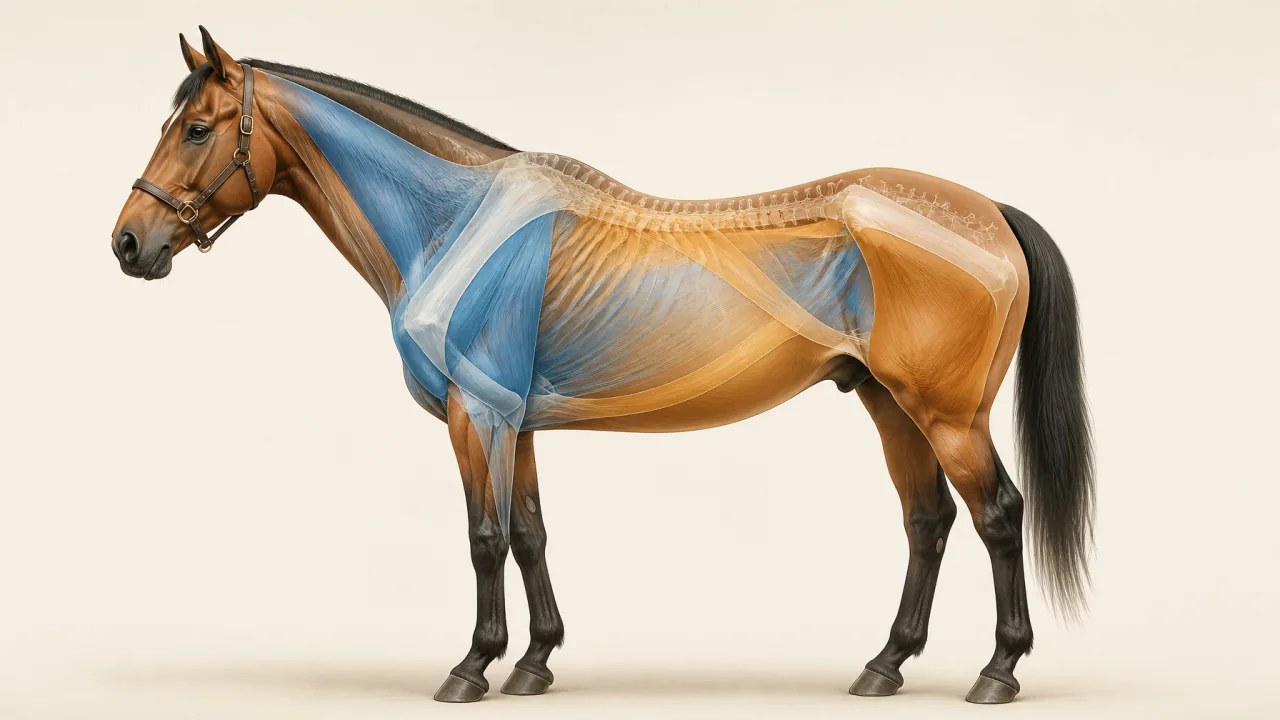
Your horse’s muscular sling matters because it helps suspend the ribcage between the forelimbs, stabilize the shoulders, support posture, and coordinate movement with the spine. Since horses do not have a functional collarbone connecting the forelimbs to the trunk, soft tissue has an especially important structural role.
Christa Martin, CEMST, Horsealytics.
The muscular sling is not one muscle. It is a connected system of muscles, fascia, and related support structures that links the forelimbs, chest, neck, thoracic spine, lumbar spine, abdomen, and pelvis. Its function can influence how comfortably and efficiently the horse carries the trunk during standing and movement.
What is the equine muscular sling?
The equine muscular sling, also called the thoracic sling, is the soft-tissue connection between the forelimbs and the horse’s ribcage.
Unlike humans, horses lack a functional collarbone connecting the forelimbs to the trunk; instead, the equine muscular sling operates as a synsarcosis—a specialized soft-tissue and fascial suspension system that cradles the ribcage.
In humans, the collarbone helps connect the upper limbs to the trunk. Horses lack that functional bony bridge, so the forelimbs are connected to the body through muscles and fascia.
This arrangement is sometimes described anatomically as a synsarcosis, meaning a muscular connection rather than a conventional bony joint. It allows the scapula to glide against the ribcage while the thorax is suspended between the front limbs.
The equine muscular sling is a dynamic soft-tissue support system that helps hold the thorax between the forelimbs while allowing the shoulders to move freely.
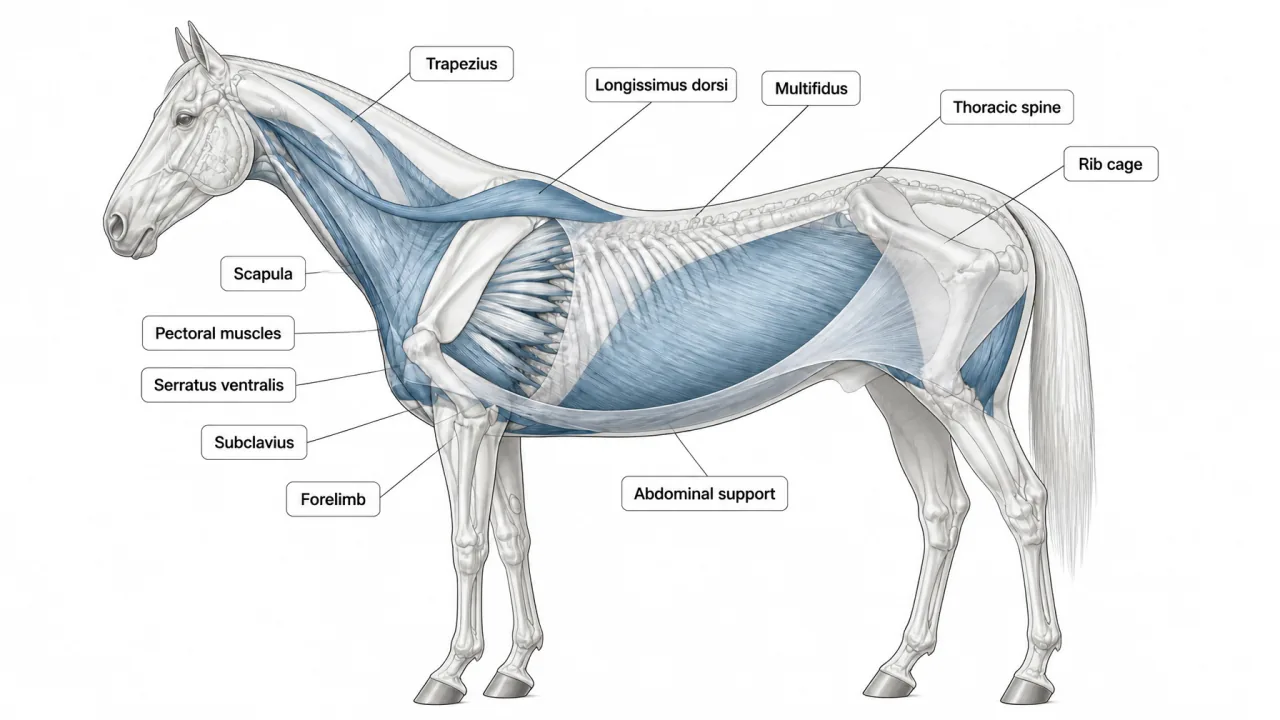
Important structures commonly associated with the muscular sling include:
- The serratus ventralis, which lies partly on the inner surface of the scapula and connects the scapula with the neck and ribs
- The superficial and deep pectoral muscles, which occupy the chest between and beneath the forelimbs
- The subclavius, also called the prescapularis in equine anatomy
- The trapezius and rhomboideus, which contribute to scapular positioning and movement
- The latissimus dorsi, which connects the forelimb region with the thoracolumbar fascia and helps coordinate limb and trunk movement
- Fascia linking the shoulder, ribcage, back, abdominal wall, and pelvic region
- Related neck, abdominal, epaxial, and pelvic support structures
These tissues do not work in isolation. They respond to ground forces, changes in balance, limb movement, posture, and the position of the trunk.
Why does the muscular sling matter for balance and movement?
The muscular sling helps control how the ribcage is positioned between the forelimbs.
The equine muscular sling is not a single muscle, but an interconnected functional web linking the serratus ventralis, pectoral muscles, latissimus dorsi, and thoracolumbar fascia to coordinate trunk suspension and forelimb freedom.
This affects the horse’s center of mass, shoulder freedom, and ability to coordinate the forehand with the rest of the body.
When the thorax is adequately supported, the scapula has room to glide over the ribcage during each stride. That movement contributes to forelimb reach, shock absorption, turning, and changes in direction. The sling also helps the horse shift weight from one forelimb to the other while maintaining trunk control.
This does not mean that every visible movement problem comes from the muscular sling. Balance and coordination also depend on the feet, joints, nervous system, vision, training, conformation, saddle, and many other factors. The sling is one important part of a larger movement system.
The muscular sling helps convert forelimb forces into coordinated trunk movement, so shoulder freedom and whole-body balance are closely connected.
How is the muscular sling related to spinal support?
The relationship between the muscular sling and the spine is indirect but important. The sling does not replace the muscles that stabilize the vertebrae. Instead, it helps determine how the ribcage, shoulders, and trunk are positioned relative to the thoracic and lumbar spine.
The serratus ventralis, pectoral muscles, latissimus dorsi, abdominal fascia, and thoracolumbar fascia form mechanical connections across the front and middle of the body. These connections help transfer forces between the forelimbs, ribcage, spine, abdomen, and hindquarters.
The thoracic spine supports the ribcage and forms the bridge between the forehand and lumbar region. The lumbar spine receives and transfers forces between the thorax, pelvis, and hindquarters. A change in thorax position can therefore alter the demands placed on the muscles alongside the spine.
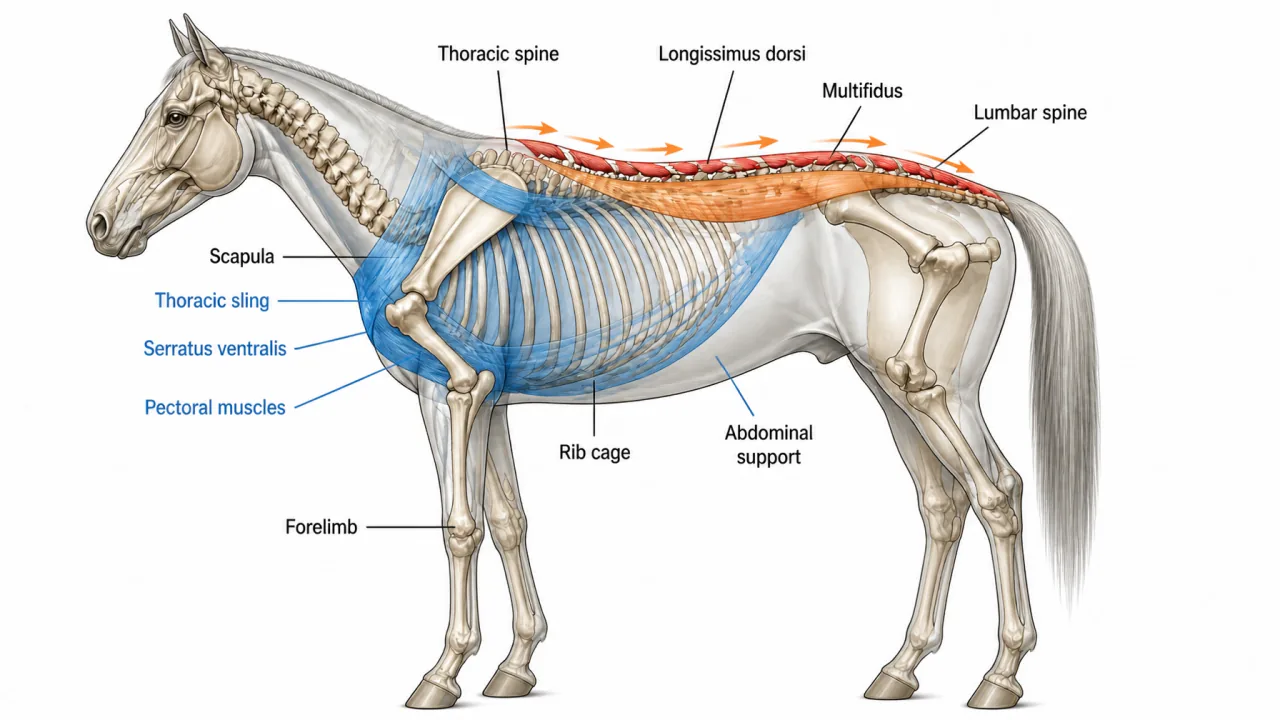
Where do the longissimus dorsi and multifidus fit?
The longissimus dorsi is a large epaxial muscle running alongside much of the thoracic and lumbar spine. It contributes to spinal extension, posture, and control of trunk movement.
The multifidus is made up of shorter, segmental muscles located close to the vertebrae. These muscles contribute to fine control and stability between individual spinal segments.
The muscular sling, longissimus dorsi, multifidus, abdominal wall, and pelvic support structures form overlapping systems. Anatomically, this makes it reasonable to discuss them together when considering posture and load transfer. However, the exact effect of thoracic sling function on spinal loading is not fully quantified in equine research.
A poorly coordinated or insufficiently supportive sling may increase the need for other tissues to help stabilize the trunk. That is a biomechanical possibility, not a diagnosis. Back discomfort can have many causes and requires professional assessment.
The muscular sling supports spinal function by helping organize the position and movement of the ribcage, while longissimus dorsi and multifidus provide important spinal control close to the vertebrae.
Can an uneven muscular sling relate to back discomfort?
It can be one possible factor, but an uneven appearance or movement pattern does not prove that the sling is the cause of discomfort.
Differences between sides may relate to natural asymmetry, training, hoof balance, previous injury, saddle fit, limb pain, spinal pain, muscle fatigue, or neurological issues. A horse that resists turning, changes posture, moves differently in one direction, or reacts to touch may need evaluation rather than a muscle-focused assumption.
The safest interpretation is that muscular sling asymmetry can be a useful observation to share with a veterinarian, qualified bodyworker, saddle professional, or rehabilitation professional. It should not be treated as a standalone diagnosis.
While soft-tissue asymmetry and soreness patterns provide valuable clues regarding posture and load transfer, equine bodywork is a supportive wellness modality and never a substitute for a formal veterinary diagnosis.
Why does anatomically correct equine massage matter?
Anatomically correct equine massage matters because the horse’s shoulders, muscular sling, rib cage, back, fascia, and spine function as a connected system rather than as isolated parts. Understanding where major soft-tissue structures actually lie helps a practitioner interpret what they are feeling and why a horse may respond differently from one region to another. Horses suspend the trunk between the forelimbs through soft-tissue structures rather than a functional collarbone, which is one reason accurate anatomy is especially relevant when discussing the thoracic sling and shoulder region.[^1][^2]
Accurate anatomical knowledge helps a practitioner understand the relationship between muscles, fascia, the muscular sling, shoulders, rib cage, back, and spine. It also helps the practitioner stay within appropriate soft-tissue boundaries, recognize asymmetry or unusual sensitivity, and understand when a finding is outside the scope of supportive bodywork and should be referred to a veterinarian. Segmental spinal muscles such as the multifidus and larger epaxial muscles such as the longissimus dorsi contribute to spinal control, while the thoracic sling helps position the trunk relative to the forelimbs and thorax, so soft-tissue observations need to be interpreted in context rather than in isolation.[^3][^4]
This is important for owners as well. Anatomically correct massage is not simply about technique. It supports safer communication about what may be contributing to postural strain, guarding, or uneven comfort without overreaching into diagnosis. Anatomically correct massage is not a diagnosis and does not replace veterinary care.
Why can soreness patterns be useful clues?
Identifying where a horse is sore can give both the practitioner and owner useful clues about training-related soreness, workload, movement patterns, tack or saddle concerns, compensation, and whether future training or management changes should be discussed with the horse’s care team. A horse that is repeatedly sensitive in the shoulder, rib cage, back, or girth area may be showing a pattern worth tracking, especially when that pattern appears alongside changes in performance, posture, or willingness to work.[^4][^5]
Soreness patterns can matter because horses often compensate when movement is uncomfortable. Compensation can shift load to other tissues, change how the horse uses the forehand or back, and influence how the saddle area or thoracolumbar region responds over time. That does not tell us the cause by itself, but it can help owners ask better questions and decide when broader evaluation is appropriate.[^4][^6]
A sore horse is not a happy horse!
Soreness is a clue, not a diagnosis, and persistent, severe, sudden, or unexplained soreness warrants veterinary evaluation before bodywork continues.
Does massage strengthen the muscular sling?
Massage may support relaxation, circulation, body awareness, and soft-tissue comfort, but massage by itself does not build muscle strength in the same way that progressive, appropriate conditioning can.
Massage may be used as part of a broader wellness or rehabilitation plan when the horse is suitable for touch-based care. It should not be used to force movement through pain, disguise lameness, or replace an evaluation.
Horsealytics provides horse massage as a supportive service for horse owners. Sessions are intended to complement responsible veterinary and performance care, not replace veterinary diagnosis or treatment.
Can saddle fit be affected by the muscular sling?
Yes, the relationship can work in both directions.
Changes in muscle tone, posture, shoulder movement, or the shape of the thoracic region may influence how a saddle sits and moves. In turn, an unsuitable saddle may interfere with scapular glide or create pressure that changes the horse’s movement and posture.
Saddle fit is only one possible contributor to movement or comfort concerns. A saddle evaluation should be considered alongside veterinary assessment and qualified examination of the horse’s movement and soft tissues.
When should a horse receive professional evaluation?
Professional evaluation is appropriate when a horse shows persistent or sudden changes such as:
- Unexplained lameness or a shortened stride
- Reluctance to move, turn, bend, or transition
- Sensitivity around the back, girth, chest, shoulder, or neck
- Repeated resistance under saddle
- New difficulty maintaining balance
- Uneven muscle development or a visible change in posture
- Heat, swelling, marked tenderness, or restricted movement
- Changes after a fall, collision, illness, injection, surgery, or intensive work
Sudden severe pain, inability to bear weight, neurological changes, significant swelling, or signs of systemic illness warrant prompt veterinary attention.
How do PEMF and red light therapy relate to supportive care?
PEMF and red light therapy are complementary wellness modalities, not replacements for veterinary care.
Red light therapy uses selected wavelengths of light directed toward tissues near the treatment area. PEMF uses pulsed electromagnetic fields. Their mechanisms are different, and evidence for specific equine outcomes varies by device, dosage, condition, and study quality.
They may be considered within a professional supportive-care plan for comfort or recovery, but Horsealytics does not present them as cures or as substitutes for diagnosis. Any horse with unexplained pain, lameness, swelling, or declining performance should be assessed appropriately first.
Massage, PEMF, and red light therapy are complementary wellness tools that may support comfort and recovery, but they are never substitutes for veterinary diagnosis or medical treatment.
When should massage be postponed?
Massage should be postponed when there is unexplained acute pain, heat, swelling, suspected injury, active skin disease, fever, contagious illness, recent surgery, or a sudden change in movement that has not been evaluated.
Massage may also need to wait until a veterinarian gives clearance after trauma, injections, surgery, or a diagnosed medical condition. Postponing a session is a safety decision, not a failure to provide care.
Frequently Asked Questions
What is the muscular sling in a horse?
The muscular sling is the connected system of muscles and fascia that suspends the horse’s ribcage between the forelimbs and links the shoulders with the trunk.
It includes the serratus ventralis, pectoral muscles, subclavius, trapezius, latissimus dorsi, fascia, and related neck, back, abdominal, and pelvic support structures.
Why is the muscular sling important for spinal support?
The muscular sling supports spinal function by controlling the position and movement of the ribcage in relation to the thoracic and lumbar spine.
It works alongside the longissimus dorsi, multifidus, abdominal wall, and pelvic support structures. This relationship is anatomically and biomechanically plausible, although the precise clinical effects are not fully established by high-level equine trials.
Do horses have a collarbone?
Horses do not have a functional collarbone connecting each forelimb to the trunk, so muscles and fascia provide the main soft-tissue connection between the forelimbs and ribcage.
This arrangement allows shoulder mobility but also makes coordinated soft-tissue support important.
Which muscles are involved in the muscular sling?
The primary muscles include the serratus ventralis, pectorals, subclavius, trapezius, rhomboideus, and latissimus dorsi, with support from connected fascia and neck, back, abdominal, and pelvic structures.
The exact contribution of each muscle changes with posture, gait, limb loading, and movement demands.
Can an uneven muscular sling relate to back discomfort?
An uneven muscular sling may be associated with altered movement or back comfort, but asymmetry alone cannot identify the cause.
Veterinary, saddle, hoof, training, and rehabilitation factors should all be considered before drawing conclusions.
Does massage strengthen the muscular sling?
Massage can support soft-tissue comfort and relaxation, but it does not replace progressive conditioning and should not be described as a strengthening method by itself.
Massage is best viewed as one supportive service within a broader care plan.
Can saddle fit be affected by the muscular sling?
Changes in sling-related posture, shoulder movement, or muscle shape may influence saddle fit, while saddle pressure may also affect movement and soft-tissue comfort.
A qualified saddle professional and veterinarian may both be valuable when concerns persist.
What signs warrant professional evaluation?
Persistent pain, lameness, sudden movement changes, unusual sensitivity, swelling, restricted motion, balance changes, or resistance under saddle warrant professional evaluation.
Urgent veterinary attention is appropriate for severe pain, inability to bear weight, neurological signs, or significant trauma.
How do PEMF and red light therapy relate to supportive care?
PEMF and red light therapy may be used as complementary wellness modalities, but their role depends on the horse, the device, and the clinical context.
They should not delay veterinary assessment or be promoted as replacements for medical treatment.
When should massage be postponed?
Massage should be postponed for unexplained acute pain, heat, swelling, suspected injury, fever, contagious illness, recent surgery, or sudden changes in movement until appropriate professional guidance is obtained.
Safety comes before scheduling a wellness session.
Horsealytics supportive care
Horsealytics offers horse massage for owners seeking supportive soft-tissue care. The goal is to complement attentive ownership, veterinary care, appropriate saddle evaluation, and responsible conditioning.
To learn more or discuss service availability, contact Horsealytics at (858) 848-9862 or visit the Horsealytics Facebook page.
Supportive services are not a substitute for veterinary diagnosis or treatment.
Sources and image credits
- Onlinepethealth: Anatomy and Function of the Equine Thoracic Sling
- Horses Inside Out: Improving the Equine Thoracic Sling
- Horse Movement: Structure, Function and Rehabilitation
- Merck Veterinary Manual: Lameness in Horses
- American Association of Equine Practitioners
- Horsealytics Facebook page
Each image is intended to add anatomical context and is not a diagnostic aid.