
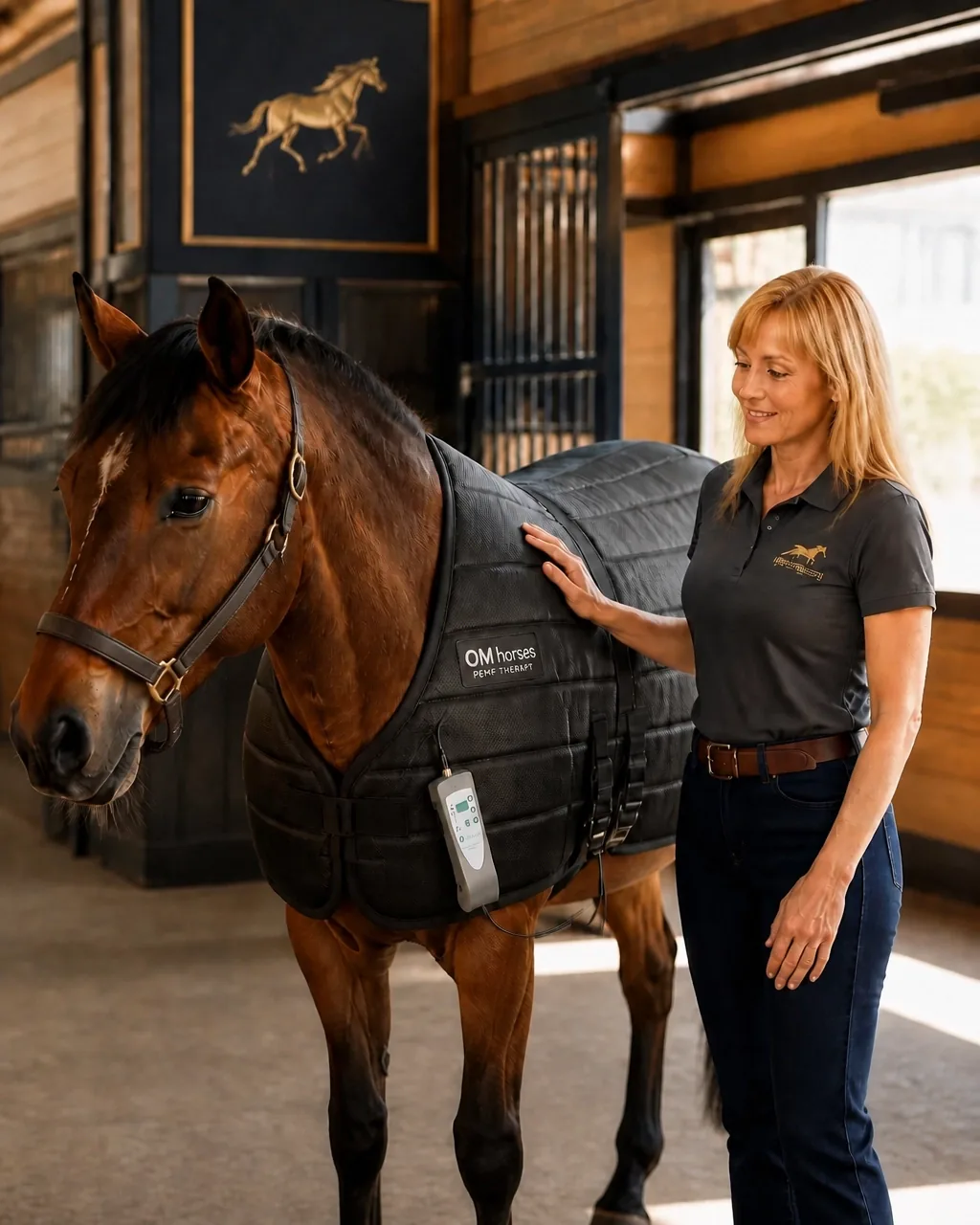
A sore horse is not a happy horse!
“Every horse carries its miles differently—what unbinds a tight shoulder on a seasoned campaigner after a weekend of showing might overstimulate a sensitive younger gelding, which is why a fixed-frequency setting rarely fits every equine athlete.” — Christa Martin, CEMST, Horsealytics
What is PEMF for horses?
Pulsed electromagnetic fields are changing magnetic fields produced in repeated pulses. In a PEMF system, a controller sends electrical signals through induction coils inside an applicator. Those coils generate time-varying magnetic fields that pass through nearby tissues.
The OMI Horses product information describes a frequency range of 1–99 hertz, or Hz. Hertz means cycles per second. A setting of 10 Hz represents a repeating pattern occurring 10 times per second. Frequency is only one part of a PEMF signal.
The equine system is designed for regional and large-area use. Its listed components and features include:
- An AC adapter and controller
- PU-leather applicators with sponge material
- Adjustable straps
- A blanket containing eight copper induction coils
- Front-leg and rear-leg wraps
- A neck wrap
- A shoulder band
- Programs P1, P2, and P3
- Frequency options from 1–99 Hz
- Session-time settings from 1–30 minutes
- A listed two-year warranty
- Durable, easy-to-clean materials
- Applicators for both large and small body areas

What are the components of the Oxford Omni Perf System?
A Whole Body Approach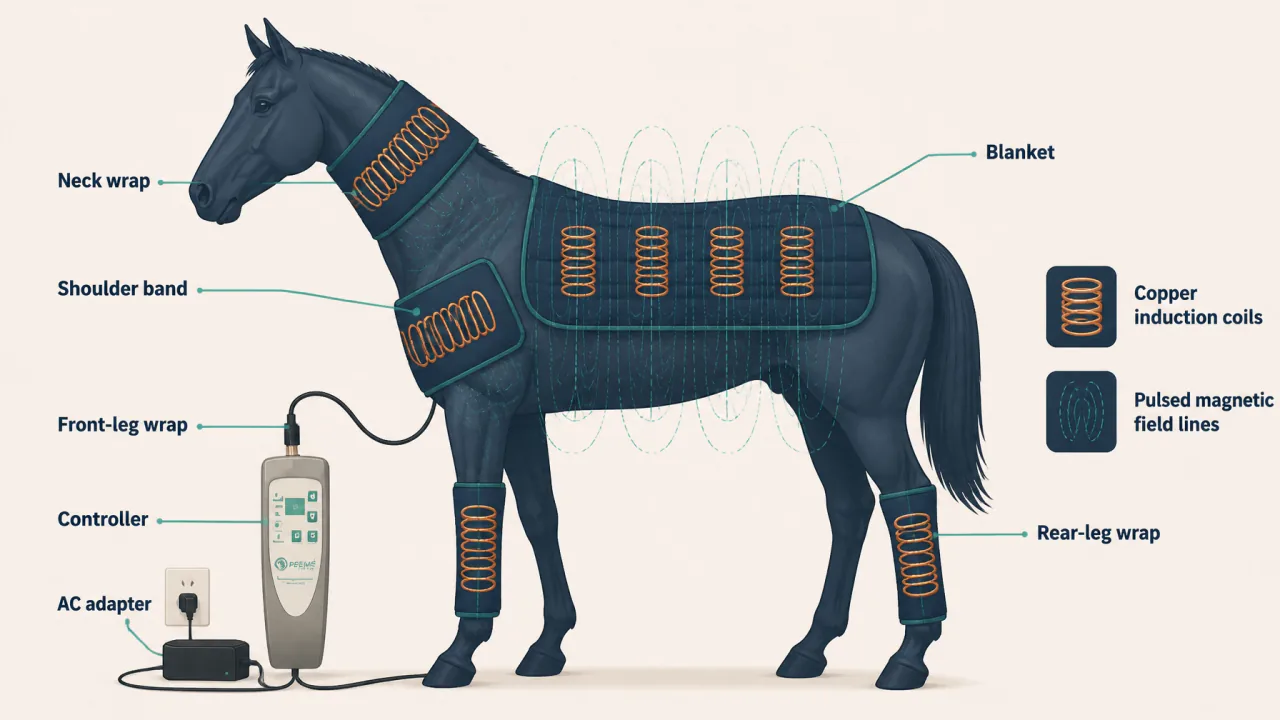
“Programmability is essential in equine PEMF because tissue recovery isn't static; a customizable system allows you to adapt from gradual frequency sweeps for general nervous-system unwinding to targeted, steady frequencies for specific soft-tissue support as a horse's workload shifts.” — Christa Martin, CEMST, Horsealytics
How do the OMI PEMF Horse programs work?
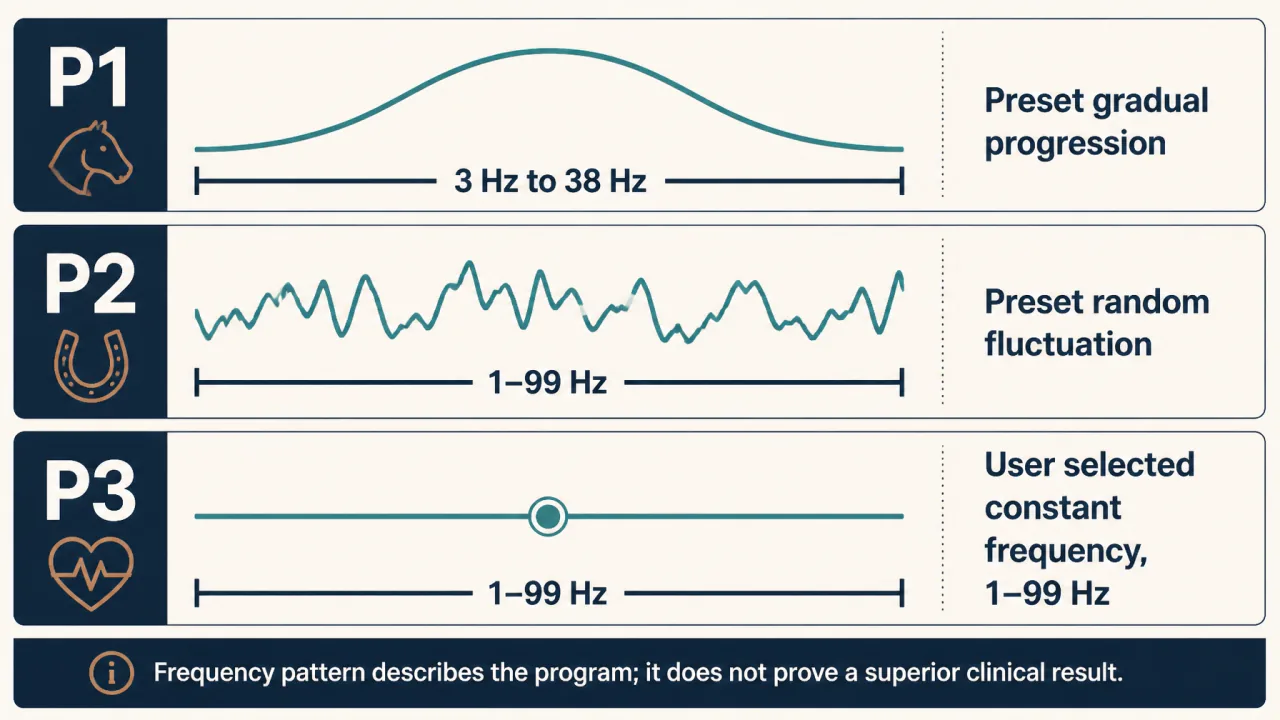
The three programs differ mainly in how frequency changes during a session. The official usage page describes P1 and P2 as preset patterns, while P3 allows the user to choose a constant frequency.
P1: Gradual frequency progression
P1 is a preset program in which the frequency gradually rises from 3 Hz to 38 Hz and then returns to 3 Hz.
“Frequency gradually increases from 3 Hz to 38 Hz and then drops back.”
This creates a changing, broad exposure pattern rather than holding the horse at one constant frequency. For a horse whose response is not yet known, a gradual progression may be considered a practical starting concept because it does not require the practitioner to choose one exact frequency.
P1 may be considered in a professional wellness plan focused on general relaxation, routine support, or a broad session goal. However, the gradual pattern itself does not prove that P1 produces better clinical results than P2 or P3. Program choice should still reflect the horse, the body region, and the advice of the veterinarian or rehabilitation professional.
P2: Random frequency fluctuation from 1–99 Hz
P2 is a preset pattern that continually and randomly changes between 1 and 99 Hz.
“Frequency continually and randomly changes between 1–99 Hz.”
Random frequency variation is different from a fixed setting. Instead of repeating one selected frequency, the controller moves through a wide range in an unpredictable pattern. Some owners or practitioners may consider this type of program for general relaxation, post-exercise comfort, or recovery support when they want broad frequency variation.
The manufacturer describes P2 as supporting maximum relaxation. That wording is a product claim, not a guarantee for every horse. Individual responses can differ, and precise equine clinical evidence for this specific program remains limited.
P3: User-selected constant frequency
P3 allows the user to choose a constant frequency between 1 and 99 Hz.
“The frequency is adjustable between 1 and 99 Hz.”
A constant setting may be useful when a trained practitioner is following a documented wellness or rehabilitation plan. It can also help when comparing a horse’s response over several sessions because the frequency remains consistent.
P3 should not be viewed as a way to select a proven cure for a named disease. A chosen frequency is one part of a session plan, and the reason for selecting it should come from professional guidance, the horse’s history, and careful observation.
“PEMF blankets and targeted applicators are powerful tools for managing post-exercise soreness and circulation, but technology should always complement—never replace—the observant eye and hands of an experienced horseman.” — Christa Martin, CEMST, Horsealytics
OMI Horses program comparison
| Program | Frequency behavior | What makes it different | When it may be considered in a professional wellness plan |
|---|---|---|---|
| P1 | Gradually rises from 3 Hz to 38 Hz, then drops back | Preset progression across a moderate range | Broad, non-constant exposure when the horse’s response is unknown |
| P2 | Randomly changes between 1 and 99 Hz | Preset wide-range variation | General relaxation or recovery support when broad variation is desired |
| P3 | Holds a user-selected frequency from 1–99 Hz | Consistent, customizable frequency | A documented plan requiring repeatable sessions and comparison over time |
The official usage page lists session times from 1–30 minutes. The best duration is not automatically the longest available setting. Session length should fit the goal, body region, workload, age, temperament, prior response, and professional recommendations.
What benefits are associated with equine PEMF?
The official OMI materials describe PEMF as a low-intensity, comfortable wellness modality for muscles, ligaments, tendons, and joints. Manufacturer materials describe potential support for:
- Relaxation and a calming effect
- Muscle soreness and tension support
- Post-exercise comfort and recovery
- Exercise-related discomfort support
- Healthy circulation and blood-flow regulation
- Healthy cell function
- Nutrient transport
- Removal of waste products associated with tissue stress
- Regeneration and recovery processes
- Healthy joint function
- Range of motion and mobility
- Biomechanical efficiency
- Soft-tissue wellness involving muscles, ligaments, and tendons
Muscle strain and soreness, exercise-induced pain, saddle soreness, and facet joint pain among its recommended applications. These are manufacturer-supported uses, not proof that the device diagnoses or resolves the underlying problem.
The system is designed for simple operation, uses an AC adapter, offers adjustable straps for fit, and includes applicators for both large and smaller regions. PU-leather materials are durable and easy to clean. The blanket’s eight copper induction coils are intended to support a broad application area.
PEMF may support a horse’s wellness routine, but it should never be used to hide a problem that needs diagnosis.
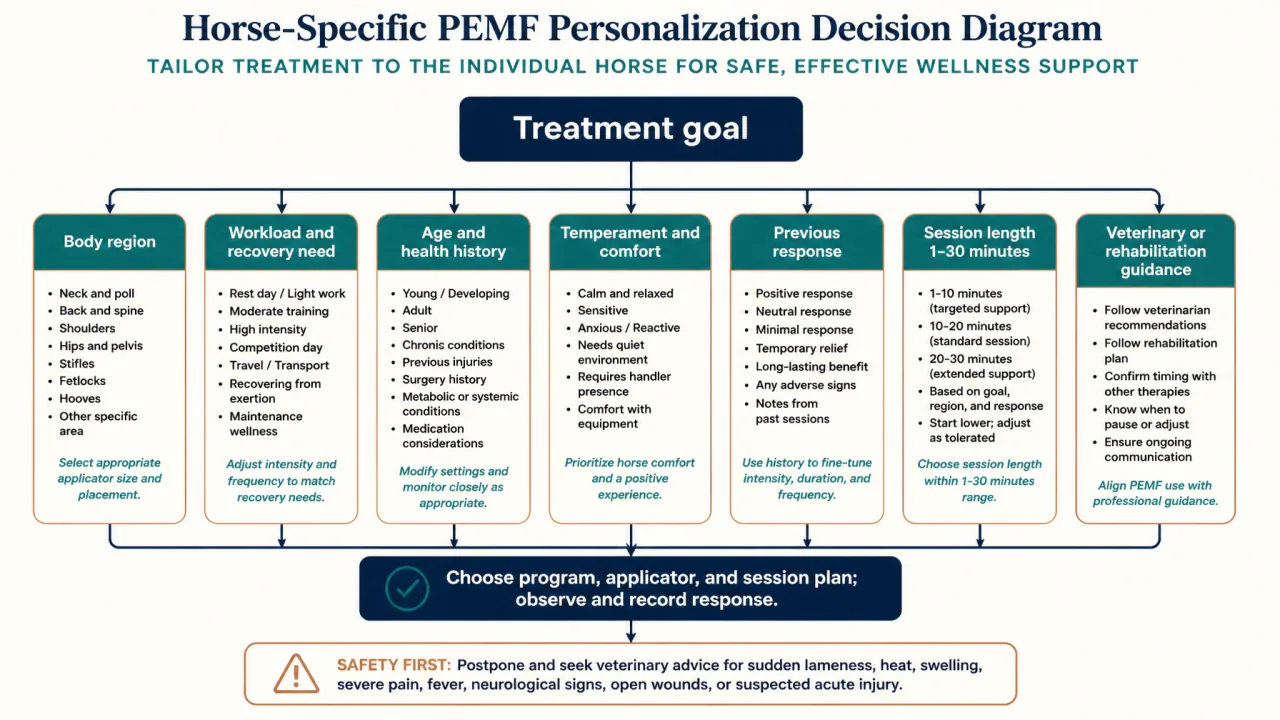
Why personalization matters
Two horses can have the same workload and respond differently to a PEMF session. One may stand quietly and relax, while another may become restless or show no noticeable change. Personalization helps keep the session connected to the horse instead of treating the program as a one-size-fits-all prescription.
A professional plan may consider:
- The main goal, such as relaxation, post-work comfort, or rehabilitation support
- The body region requiring attention
- Whether the horse is in light work, intense training, competition, or rest
- Age, health history, and current medications
- Temperament and tolerance for wearable equipment
- Previous response to PEMF or other bodywork
- Applicator size and placement
- Session length between 1 and 30 minutes
- Veterinary or rehabilitation guidance
- Competition or governing-body rules
Applicator placement should match the intended body region. The blanket is suited to large-area applications, while the leg wraps, neck wrap, and shoulder band are designed for more regional use. Straps are secured without creating pressure, rubbing, heat, or restriction. The horse is observed throughout the session, and the equipment is removed if the horse appears uncomfortable.
What does the evidence say?
PEMF research is not the same as proof for every equine device, program, frequency, or condition. Human whole-body research is also limited. A systematic review available through PubMed found insufficient evidence to recommend low-frequency whole-body PEMF devices for therapeutic use without stronger research. Those findings cannot be transferred directly to horses or to the OMI Horses system.
Equine evidence and precise horse-specific protocols are still developing. Research may examine a different device, intensity, applicator, treatment schedule, or health problem than the one being considered. For that reason, manufacturer claims should be separated from established clinical evidence.
Horsealytics views equine massage and related wellness services as supportive care. Christa Martin, CEMST, Horsealytics, can help horse owners think about comfort, movement, and soft-tissue wellness, but these services are not a substitute for veterinary diagnosis or treatment. Contact Horsealytics at (858) 848-9862 or visit the Horsealytics Facebook page.
Safety and veterinary care
Safety depends on the device, the horse, the placement, the session plan, and veterinary guidance. Follow the product manual and ask a veterinarian about possible precautions, especially for pregnant mares, foals, horses with implanted electronic devices, serious illness, recent surgery, or upcoming competition.
A veterinarian should evaluate a horse with sudden lameness, heat, swelling, severe or unexplained pain, fever, neurological signs, an open wound, or suspected acute injury. PEMF should not delay examination, imaging, medication, rest, or other treatment when those services are needed.
Supportive wellness begins with knowing when a horse needs medical care.
Frequently asked questions
What is PEMF for horses?
"What actually is a PEMF blanket for horses and how do the magnetic fields work on their muscles?"
Pulsed electromagnetic fields are changing magnetic fields produced in repeated pulses. In a PEMF system, a controller sends electrical signals through induction coils inside an applicator to pass changing magnetic fields through equine soft tissue. Systems like the OMI Horses blanket offer adjustable frequency ranges (1–99 Hz) to support general relaxation, circulation, and post-exercise comfort.
Why use PEMF for horses?
"Why should I use a programmable PEMF system instead of a basic blanket with preset frequencies?"
Horse owners and bodywork practitioners utilize PEMF to support cellular function, encourage healthy circulation, and aid in the removal of metabolic waste products following physical exertion. "Programmability is essential in equine PEMF because tissue recovery isn't static; a customizable system allows you to adapt from gradual frequency sweeps for general nervous-system unwinding to targeted, steady frequencies for specific soft-tissue support as a horse's workload shifts."— Christa Martin, CEMST, Horsealytics
When should I ask for a PEMF session for my horse?
"When is the best time to schedule a PEMF session for a horse after a hard show weekend or heavy trailering?"
PEMF sessions are ideal during regular maintenance intervals, after heavy workloads (such as a weekend of showing or strenuous trailering), or as part of a structured conditioning and recovery plan for an equine athlete. "PEMF blankets and targeted applicators are powerful tools for managing post-exercise soreness and circulation, but technology should always complement—never replace—the observant eye and hands of an experienced horseman."— Christa Martin, CEMST, Horsealytics
What is Omni Perf or OMI Horses PEMF?
Verified official materials describe OMI Horses from Oxford Medical Instruments as an equine PEMF system with regional applicators, a blanket, three programs, and a 1–99 Hz frequency range.
How do P1, P2, and P3 differ?
P1 gradually progresses from 3 Hz to 38 Hz and back down. P2 randomly changes between 1 and 99 Hz. P3 lets the user select one constant frequency between 1 and 99 Hz.
What does 1–99 Hz mean?
Hz means hertz, or cycles per second. The number describes frequency, not treatment strength or a guaranteed clinical effect.
Why might personalized settings matter for one horse more than another?
Two horses doing similar work may still respond differently because workload, temperament, body region, comfort level, and recovery needs are not identical. That is why a professional wellness plan may use different programs, frequencies, applicators, or session lengths for different horses.
How long are sessions?
The official usage page lists time settings from 1–30 minutes. The appropriate duration depends on the horse and the professional wellness plan.
Which program is best?
There is no universally best program. A trained professional may choose P1, P2, or P3 based on the goal, horse, body region, and previous response.
Can settings be tailored?
Yes. Program type, frequency when using P3, applicator, body region, and session length can be considered alongside veterinary or rehabilitation guidance.
What benefits are claimed?
Manufacturer materials describe support for relaxation, circulation, recovery, muscle and soft-tissue wellness, joint function, mobility, and exercise-related comfort. These claims are not guarantees.
Can PEMF replace veterinary care?
No. PEMF is complementary wellness support and cannot replace diagnosis, medical treatment, or emergency care.
What should owners track?
Record the program, frequency, applicator, body region, session length, workload, temperament, comfort signals, and changes in movement or recovery. Share meaningful changes with the horse’s veterinarian.
When should a session be postponed?
Postpone the session and seek veterinary guidance for sudden lameness, heat, swelling, severe pain, fever, neurological signs, open wounds, suspected acute injury, or any unexplained decline.
References
- OMI Horses: How to Use
- OMI Horses Product Information Sheet
- Oxford Medical Instruments: PEMF Blanket for Horses
- PubMed: Systematic review of low-frequency whole-body PEMF devices
- Northeast Equi Wellness: OMI PEMF Equine Frequency Guide
The Northeast Equi Wellness frequency chart is third-party guidance, not an official OMI protocol. Its disease-specific suggestions should not be treated as established treatment recommendations.
Christa Martin, CEMST, Horsealytics, studied graduate-level Electrical Engineering at The University of Houston.