
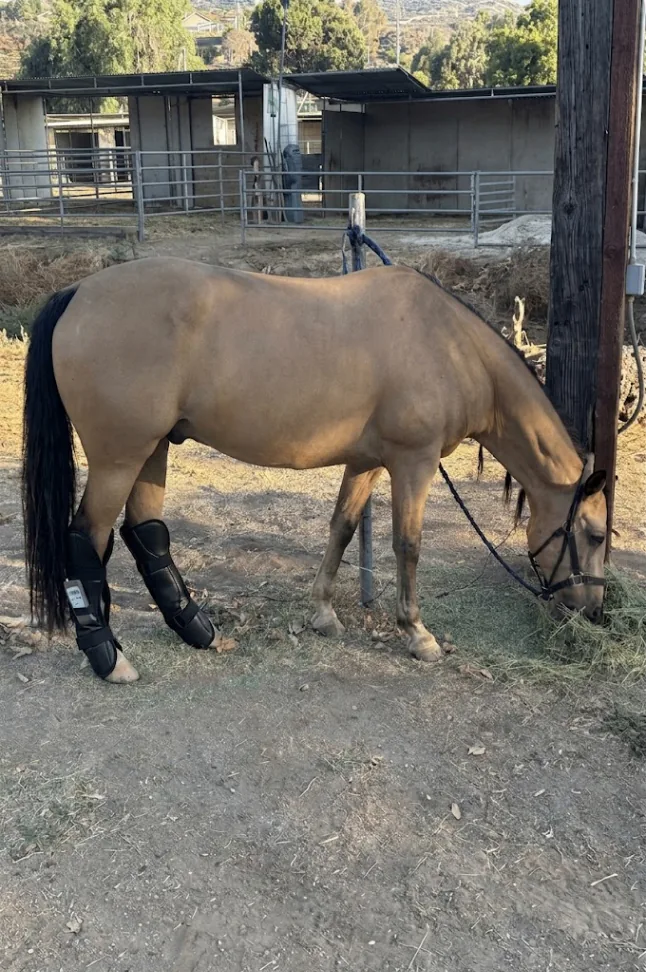
Calling a veterinarian is always the first choice after a horse casts itself or shows signs of injury. This case study is not intended to provide a diagnosis or replace veterinary advice.
A horse that casts himself can go from resting to struggling in seconds. The effort to get free may leave him sore through the legs, back, neck, and body. My own horse,Jasper, just experienced this kind of scare after becoming trapped in his stall. Through Horsealytics equine wellness and recovery services, Christa Martin, CEMST, shares case-based support from San Diego, CA, while keeping veterinary boundaries clear. In the broader bodywork context, Equissage relates to professional equine massage training and hands-on wellness support, not diagnosis.
His recovery support followed a careful sequence: first ice boots and water therapy, then red light therapy, and finally PEMF therapy. The goal was not to diagnose or cure an injury with supportive modalities. The goal was to monitor Jasper, help him stay comfortable, and support his whole-body wellness while watching for changes that required veterinary care. In this case, red light therapy refers to photobiomodulation, and PEMF support later in the timeline included the NeoRhythm OmniPEMF Pad as part of the Horsealytics care context, not as proof of a medical outcome.
Quick Summary
“After Jasper cast himself in his stall, staged supportive care focused on veterinary oversight, cold and water therapy, photobiomodulation through red light therapy, and later PEMF. This case study explains why professional bodywork and recovery modalities may support comfort while owners monitor swelling, soreness, and changing veterinary needs.”
“A sore horse is not a happy horse!”
"A horse that casts himself can go from resting to struggling in seconds, making veterinary evaluation the absolute first priority before any supportive wellness modalities—such as icing, red light, or PEMF therapy—are introduced." Christa Martin, Horsealytics, San Diego, CA
What happened when Jasper cast himself?
Jasper cast himself in his stall and struck his foot against the stall bar while trying to get back up. The event left him sore overall. During the day, his leg also began to swell slightly.
The supplied photos document Jasper during the supportive care process. They do not prove a diagnosis, the severity of an injury, or a final medical outcome.
After a horse casts himself, even a horse that is standing and eating normally may have hidden trauma. Struggling against a wall can place unusual stress on muscles, joints, tendons, ligaments, and hooves. That is why veterinary evaluation comes first, especially when swelling, heat, lameness, wounds, hoof trauma, severe pain, or a suspected fracture or tendon or ligament injury is present.
What should you do immediately after a horse casts in his stall?
The first question after a casting event is not, “Which therapy should be used?”
It is, “Could this horse have a serious injury?”
A veterinarian may need to assess the horse for wounds, unstable limbs, tendon damage, joint involvement, hoof trauma, or other problems. Signs such as non-weight-bearing lameness, an abnormal limb angle, marked heat, rapidly increasing swelling, or severe pain need prompt veterinary attention.
Signs that require urgent veterinary attention
| Red flag | Why it matters |
|---|---|
| Non-weight-bearing lameness | May signal serious pain or structural injury |
| Rapidly increasing swelling | Can indicate active inflammation or deeper trauma |
| Heat or marked tenderness | May point to acute tissue stress or injury |
| Open wounds or active bleeding | Raises concern for contamination, blood loss, or deeper damage |
| Severe or unexplained pain | Needs prompt veterinary assessment |
| Suspected fracture, tendon, or ligament injury | May require stabilization and imaging |
| Neurological changes, weakness, or incoordination | Can suggest a more serious whole-body problem |
| Fever or signs of systemic illness | May indicate a broader medical concern |
Calling a veterinarian is always the first choice. This list is not a diagnosis.
Merck Veterinary Manual guidance on emergency care for horses explains that trauma cases may require careful examination, wound management, stabilization, imaging, pain control, and other emergency treatment. Supportive services do not replace those steps.
Why did Jasper’s leg swelling require close monitoring?
In Jasper’s case, the slight swelling and overall soreness became important observations. They helped shape a gradual care plan rather than jumping immediately into more active bodywork.
"Staged supportive care ensures that early swelling and fresh trauma are properly monitored by a veterinarian, preventing adjunctive therapies from masking worsening pain or delaying essential medical treatment." Christa Martin, Horsealytics, San Diego, CA
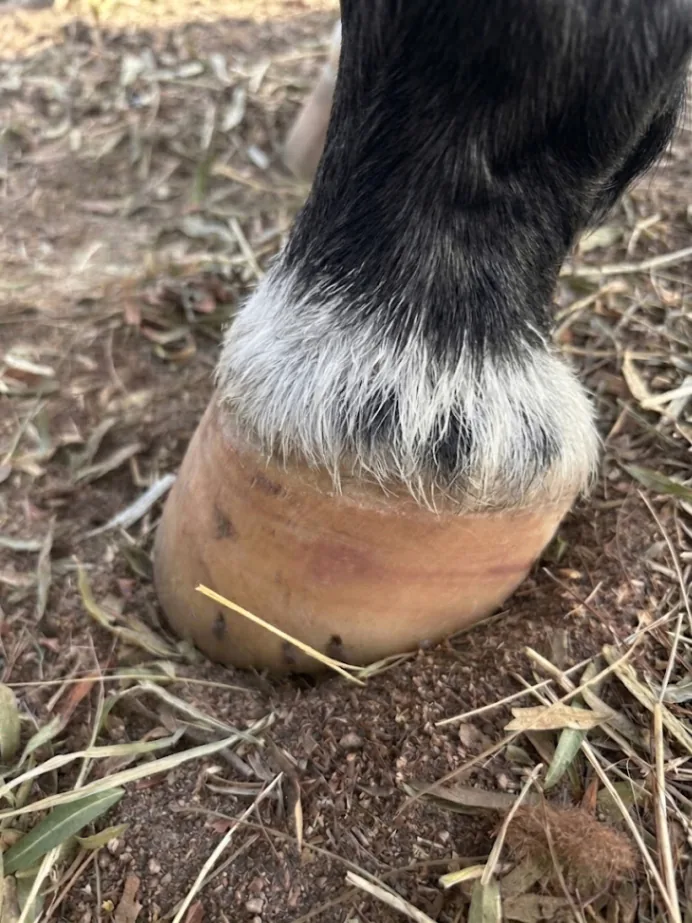
The hoof impact
The hoof photo includes a red line showing the area where Jasper struck the stall bar while attempting to rise. The red line is not a diagnostic interpretation and does not establish the depth or seriousness of the hoof trauma.
A hoof strike can be painful even when the outside appearance seems minor. Bruising, cracks, sole sensitivity, or deeper injury may not be obvious at first. A horse may also change how he loads the foot, creating extra tension elsewhere in the body.
That altered loading matters because horses compensate quickly. A sore foot may lead to guarded movement through the limb, shoulder, back, pelvis, or neck. This is one reason a whole-horse approach can be useful after an accident, while still keeping veterinary assessment at the center.
Jasper’s staged supportive care timeline
| Hours post-incident | Modality | Primary objective |
|---|---|---|
| Initial response to 24 hours | Cold therapy and water therapy | Support early comfort and allow close observation of swelling and sensitivity |
| After 24 hours | Red light therapy / photobiomodulation | Provide supportive soft-tissue wellness as part of the monitored care plan |
| After 24 to 48 hours | PEMF with the NeoRhythm OmniPEMF Pad | Provide complementary recovery support after the initial monitoring period |
This timeline describes Jasper’s case experience, not a universal protocol. A veterinarian should guide decisions after a horse casts itself.
Why was cold therapy used first?
Jasper was monitored after casting himself. When his legs began to swell slightly during the day, the consensus with the vet was to ice the leg and use water therapy as part of his care plan.
Cold therapy and water therapy are commonly used as early supportive measures for fresh swelling and discomfort. Veterinary references describe cold hydrotherapy as part of initial support for certain soft-tissue injuries, but cold therapy does not identify the cause of swelling. It also does not rule out a fracture, tendon injury, ligament injury, joint injury, or hoof problem.
The response to cold therapy should be observed, not assumed. A horse that remains painful, becomes lame, develops more heat or swelling, or shows a wound still needs veterinary evaluation.
Why was red light therapy introduced after 24 hours?
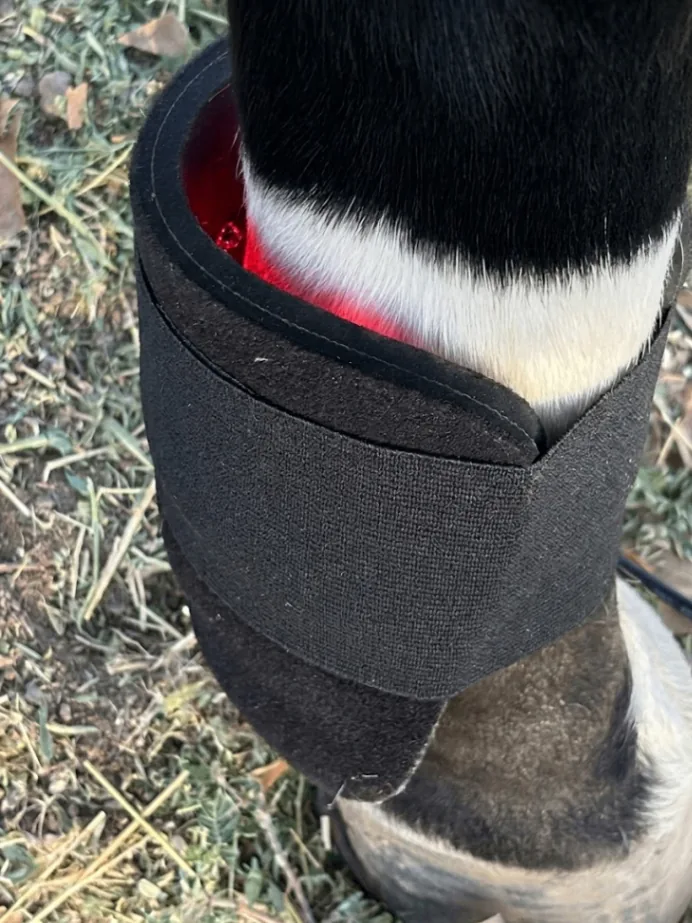
After 24 hours, Christa moved to red light therapy.
Red light therapy, also called photobiomodulation, uses visible red and near-infrared light. It may support relaxation, comfort, and soft-tissue wellness. Horsealytics uses it as a non-invasive adjunct, not as a substitute for veterinary treatment.
The research behind red light therapy varies. Results may depend on the device, wavelength, dose, treatment area, condition, and quality of the study. Evidence for one type of injury or device should not automatically be applied to every horse.
For that reason, red light therapy is best viewed as one part of a monitored wellness plan. It should not be used to cover up worsening pain or delay a veterinary examination.
Why was PEMF introduced after 24 to 48 hours?
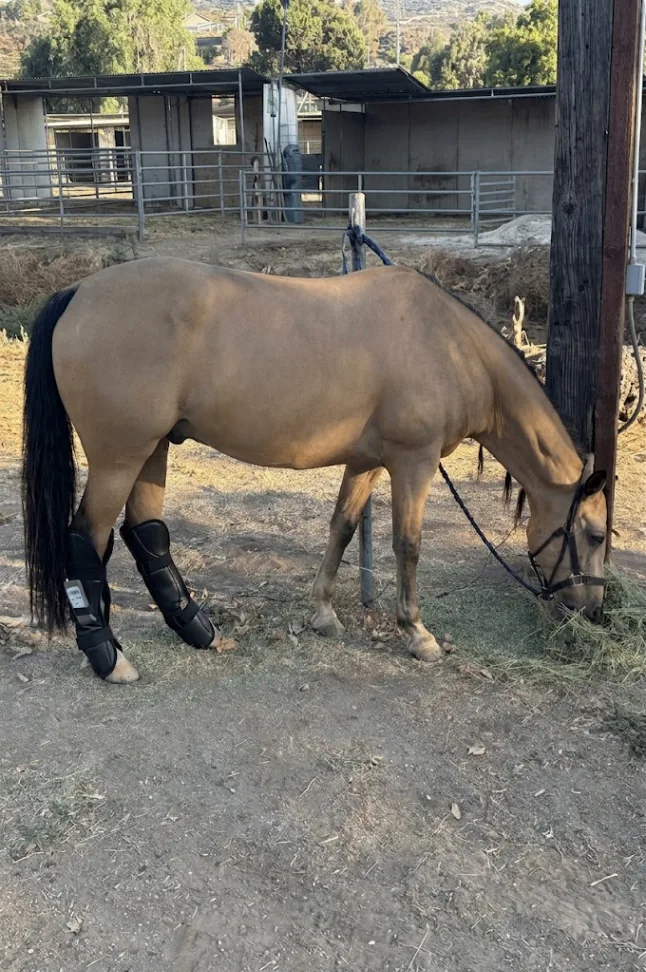
After an additional 24 to 48 hours, Christa moved to PEMF therapy. Jasper’s PEMF session was approximately 20 minutes.
PEMF, or pulsed electromagnetic field therapy, is a non-invasive modality used to support relaxation, circulation, and muscle recovery. It may be included in a care plan when the horse is comfortable enough for the session and when more urgent concerns have been addressed.
PEMF research also varies by device, setting, condition, and study quality. It should not be described as a proven treatment for an undiagnosed injury. In Jasper’s case, it was used as supportive care after the initial swelling period, not as proof that a specific injury had healed.
Why the sequence mattered
The sequence reflected the changing priorities after a traumatic event.
Early swelling and fresh soreness call for observation and veterinary decision-making. Cold and water therapy may support comfort during this stage. Once the immediate response had been monitored, red light therapy and then PEMF were added as non-invasive wellness modalities.
This does not mean every horse should follow the same timeline. A horse with a wound, heat, lameness, hoof pain, or suspected structural injury may need a different plan. The correct timing depends on the horse’s examination findings and veterinary guidance.
Staging also helps prevent one therapy from being mistaken for the reason a horse improves. It allows the owner and practitioner to observe the horse’s comfort, movement, swelling, and attitude over time.
How can bodywork support a horse after casting himself?
A casting event can leave a horse sore beyond the original point of impact. Jasper’s struggle to rise may have created whole-body tension through the hindquarters, back, abdominal muscles, shoulders, and neck.
Professional equine massage and bodywork may support:
- Relaxation after a stressful event
- Awareness of muscle guarding and tension
- General soft-tissue comfort
- Comfortable movement patterns
- Observation of changes in posture and movement
However, bodywork is not a diagnostic examination. Massage should not be performed directly over an area that is hot, acutely swollen, wounded, unstable, or suspected to be seriously injured. Vigorous manipulation during an acute injury may worsen discomfort or interfere with the veterinary care plan.
For horse owners who want more context on why massage fits into a whole-horse wellness plan, Horsealytics also offers Horsealytics’ online guide to equine massage therapy and why it supports horse comfort and recovery. For a broader explanation of how soft-tissue balance affects movement, read Horsealytics’ explanation of the equine muscular sling and spinal support.
What this case study can and cannot show
Jasper’s story shows how a horse may benefit from calm observation and staged supportive therapies after a casting event. It also shows why whole-horse soreness matters. The original accident may affect more than the hoof or leg that appears most noticeable.
This case study does not establish that icing, water therapy, red light therapy, PEMF, or bodywork treated or cured an injury. No formal veterinary diagnosis or final medical outcome was provided for this case. A vet was consulted, and the therapy was advised. The available information supports describing Jasper’s care as monitored wellness support.
The photos are visual records from the case. They are not diagnostic images, and they do not prove improvement or recovery.
What can horse owners learn from Jasper’s case?
"Professional equine bodywork and recovery modalities support whole-body relaxation and soft-tissue comfort after a stressful event, but they must always be timed carefully around the horse's specific clinical condition and professional veterinary guidance." Christa Martin, Horsealytics, San Diego, CA
A cast horse should be treated as an emergency until a serious injury has been ruled out.
| Key lesson | Why it matters |
|---|---|
| Veterinary evaluation comes first | A cast horse may have hidden trauma even if he is standing and eating |
| Staged supportive care must follow the horse’s response and professional advice | Timing matters, and supportive modalities do not replace diagnosis or treatment |
| Persistent or worsening signs require reassessment | More swelling, heat, pain, or lameness may change the care plan and need veterinary follow-up |
Medical disclaimer
Horsealytics supportive services are wellness modalities and are not a substitute for veterinary diagnosis or treatment. Equine bodywork, icing, water therapy, red light therapy, and PEMF should not delay veterinary care. Always consult a veterinarian when injury is possible.
For questions about Horsealytics services, contact Christa Martin, CEMST, Horsealytics at (858) 848-9862 or visit the Horsealytics Facebook page.
Veterinary references and further reading
The following veterinary resources provide the medical foundation for emergency assessment, trauma care, and soft-tissue injury management. They are separate from Horsealytics’ practical experience with supportive wellness services.
- Merck Veterinary Manual: Emergency Care for Horses
Covers emergency preparation, safe handling, trauma concerns, fractures, wounds, and the importance of veterinary assessment. - MSD Veterinary Manual: Trauma and First Aid in Horses
Reviews fractures, wounds, stabilization, transportation, and the need to identify damage to bones, joints, tendons, and other structures. - MSD Veterinary Manual: Tendinitis in Horses
Explains why heat, swelling, pain, and lameness can occur with tendon injury and how diagnosis may involve ultrasonography or MRI.
Evidence for adjunct therapies such as red light and PEMF varies by device, condition, setting, and study quality. Horsealytics presents these services as supportive wellness options, with the horse’s safety and veterinary care taking priority.